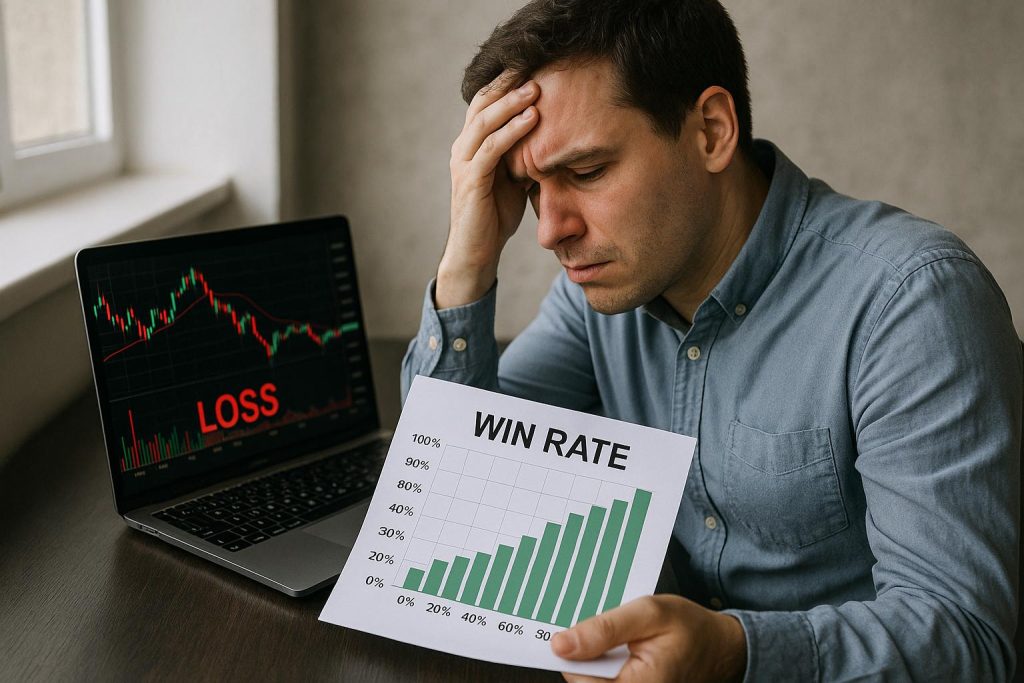
Why win rate can fool struggling traders
Written on October 16, 2026 By admin in Uncategorized
The Pitfall of High Win Rates in Trading
In the realm of trading, performance metrics are crucial in assessing the effectiveness and viability of a trading strategy. Among these, the win rate—a metric indicating the percentage of winning trades—often receives significant attention. While it may seem intuitive to assume that a higher win rate equates to greater success, this assumption can be misleading, particularly for struggling traders.
Understanding Win Rate
Win rate refers to the ratio of profitable trades to the total number of trades executed. For instance, if a trader executes 100 trades and 60 of them result in a profit, the win rate would be 60%. At first glance, a high win rate might suggest a successful and consistently profitable trading strategy. However, focusing solely on this metric without considering other essential factors can lead to erroneous conclusions.
The Illusion of High Win Rates
While a high win rate can create an impression of success, it is not an all-encompassing indicator of profitability. Several factors complicate the seemingly straightforward conclusion that a high win rate is desirable.
1. Risk-Reward Ratio: The risk-reward ratio is a critical factor that works hand-in-hand with win rates. A strategy with a high win rate but adverse risk-reward ratio might still result in losses. For example, a strategy that wins 80% of the time but sees the average loss being twice as large as the average gain is likely unprofitable in the long run. Therefore, traders must consider both the probability of winning and the extent of potential losses versus gains.
2. Sample Size and Variability: A significant aspect often overlooked is the sample size of trades. A small number of trades can generate a temporarily high win rate, not necessarily reflecting the long-term viability of the strategy. As variability and randomness can heavily influence win rates on short time frames or small sample sizes, a larger sample is necessary to obtain a more accurate picture. Without considering these factors, traders may align their conclusions with short-term trends, which can be misleading.
3. Psychological Impact: Traders focusing predominantly on win rates may inadvertently overlook other vital trading components such as risk management and strategy robustness. This narrow focus can also contribute to emotional trading, as traders may equate a string of losses to failure, even if they have a sound, long-term profitable strategy. Emotional responses can lead to suboptimal decisions, increasing the potential for losses rather than mitigating them.
Shifting Focus: Other Essential Metrics
To gain a comprehensive understanding of a trading strategy’s effectiveness, traders should consider additional metrics alongside win rate. These supplementary indicators can offer valuable insights and contribute to a more holistic view of a trading system’s strengths and weaknesses.
1. Profit Factor: This metric compares gross wins to gross losses. A profit factor greater than one indicates a potentially profitable system, representing that the strategy’s total gains outweigh its total losses. The profit factor provides insight beyond the win rate and serves as a strong indicator of a trading strategy’s overall success.
2. Average Gain and Loss: By analyzing the average gain per winning trade and the average loss per losing trade, traders can better understand how well their strategy compensates for losses. This metric can mirror the effectiveness of one’s risk-reward ratio in practice and shed light on the strategy’s efficiency. Comparing average gains and losses helps traders grasp the payout structure more realistically than a lone win rate could.
3. Maximum Drawdown: This refers to the largest peak-to-trough decline within a portfolio or strategy, offering insights into potential risks. Maximum drawdown is an essential metric for assessing the volatility and sustainability of a trading strategy. A strategy with a smaller maximum drawdown may be more robust over the long term, aiding traders in avoiding large, undesirable losses.
Conclusion
While win rate is a popular metric among traders, it does not provide a complete picture of a trading strategy’s profitability or efficiency. By considering additional factors such as risk-reward ratio, profit factor, and maximum drawdown, traders can develop a more nuanced and accurate understanding of their trading performance. This approach fosters resilience against the false security of high win rates alone. To enhance trading strategies and performance metrics, traders should remain committed to learning and discover opportunities for improvement. Consider engaging with financial resources or exploring trading communities online to broaden knowledge and understanding further.
This article was last updated on: October 16, 2026