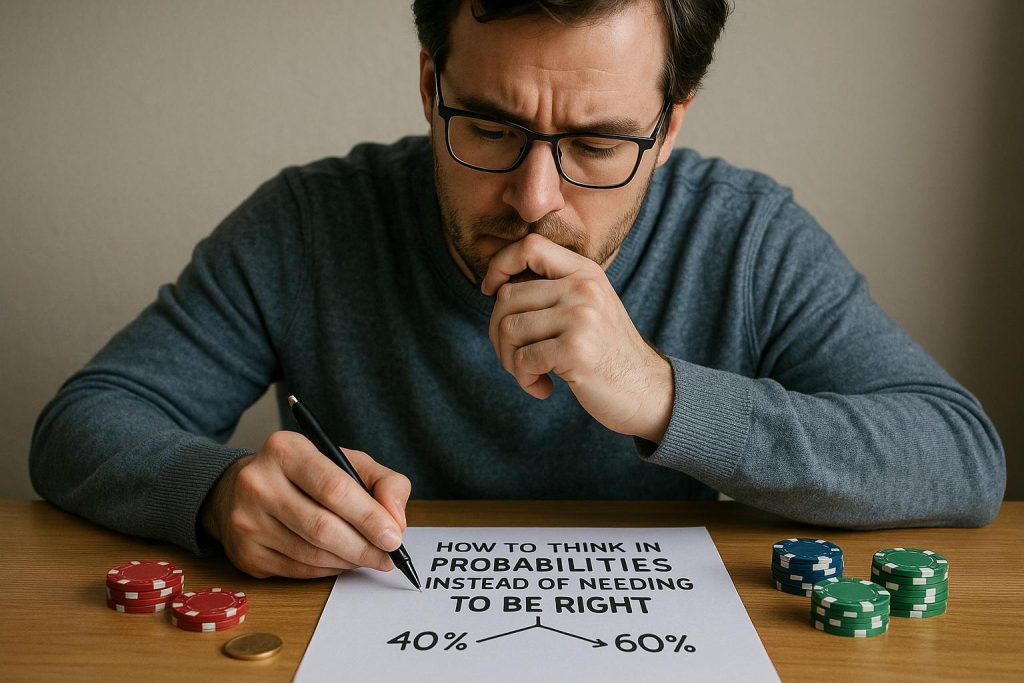
How to think in probabilities instead of needing to be right
Written on October 9, 2026 By admin in Uncategorized
Understanding the Probability Mindset
In our daily lives, many people instinctively lean towards thinking in absolutes—the tendency to view events as either certain to happen or not at all. Such binary thinking often leads individuals to strive for being correct all the time, which inadvertently fosters unnecessary stress and precipitates suboptimal decision-making. By adopting a mindset that embraces probabilities instead, individuals can shift their focus away from ultimate certainty, paving the way for greater flexibility and improved planning.
Basics of Probability Thinking
At its essence, probability serves as an instrument for quantifying uncertainty. Our experiences are replete with instances that demand probabilistic reasoning. For example, choosing whether to carry an umbrella based on a weather report is essentially a probabilistic judgement at work. Unlike deterministic thinking—which divides the world into black and white categories—probabilistic thinking acknowledges and accommodates the myriad shades of grey that exist in life.
Embracing this method does not mean forsaking precision or accuracy. Rather, it involves an acceptance of the idea that absolute certainty is a rarity and that uncertainty plays an intrinsic role in life. Recognizing this notion equips individuals to make more informed decisions, even in situations where not all deterrminant factors are within their control.
Benefits of Thinking in Probabilities
A principal benefit of adopting a probability-oriented mindset is enhanced decision-making ability. When individuals acknowledge the inherent uncertainties of various outcomes, they can prepare for a spectrum of potential scenarios, thereby fostering adaptability when faced with unforeseen changes. Additionally, probability thinking promotes perpetual learning. Realizing that each decision is, in itself, an experiment whose results are uncertain, individuals remain open to feedback, learning from their missteps, and refining their judgement over time.
Further, by reducing the pressure to always be right, probabilistic thinking alleviates the anxiety associated with uncertainty. When you evaluate decisions through a probabilistic filter, you can reconcile with ambiguity and diminish the dread that often accompanies the possibility of error.
Strategies to Develop Probability Thinking
Embrace Uncertainty: Develop an acceptance for uncertainty as an intrinsic element of life. Reframe ambiguous situations as opportunities to practice probabilistic thinking, rather than as setbacks to be dreaded.
Quantify Uncertainty: Initiate your journey by assigning simple probability estimates to possible outcomes. This could involve saying there’s a 70% likelihood of rain tomorrow, for example. Over time, these estimations can evolve to become more nuanced and informed.
Reflect on Outcomes: After decisions are made and consequences observed, take the time to reflect on the results in comparison to your original estimations. Did events unfold in a manner consistent with your initial probability assessment? Use these reflections to fine-tune your future judgement.
Use Probabilistic Language: Incorporate language signifying uncertainty into your routine communication. Utilizing terms such as “likely,” “unlikely,” and “possible,” can significantly reinforce a mindset attuned to uncertainty.
Resources for Learning More
For those interested in enhancing their proficiency in probabilistic thinking, consider exploring this insightful book dedicated to probability and decision-making. Additionally, this online course offers hands-on exercises designed to facilitate the application of these concepts in everyday life.
By transitioning from a mindset entrenched in certainties to one that acknowledges and embraces probabilities, individuals not only broaden their mental frameworks but also equip themselves with a powerful tool conducive to both personal and professional development.
In conclusion, infusing one’s life with a probability-thinking approach can yield significant dividends. It fosters a milieu of ongoing learning and adaptation, allowing individuals to strategically navigate life’s uncertainties rather than be overwhelmed by them. While it may require an initial shift in perspective, the rewards of improved decision-making, reduced stress, and sustained learning make the journey undeniably worthwhile. Understanding probabilities better aligns our perception with the real world, ultimately encouraging a more balanced, resilient, and insightful way of living.
This article was last updated on: October 9, 2026